

What is the Research Information Management Systems (RIMS) program?
The University of Saskatchewan (USask) has launched a program to modernize the administrative systems and processes that support research across campus. This will streamline research administration and improve the experience for researchers, their teams, and the staff that support them.
The RIMS Program will introduce new tools and integrated systems to better support research activities and processes. Bringing together information and processes that are currently managed across multiple systems will make it easier for researchers and their teams to navigate.
Projects

Animal Management System
A new and modern Animal Management System (AMS) is being implemented that will streamline and support activities related to the administration and physical management of animals for research, teaching, and learning purposes.

Human Ethics Research Administration System
A new Human Ethics Research Administration System is being implemented to simplify and support the submission, review, approval, and ongoing management of human ethics research applications. This project is in its initial stages and will provide researchers and Research Ethics Board reviewers with improved tools to manage the review processes and support institutional compliance requirements.
Purpose and Mandate
The Research Information Management System (RIMS) Program has been designed to align research priorities with business goals and technological capabilities, optimizing research administration throughout the University of Saskatchewan.
This collaborative initiative between the Office of the Vice-President Research and the Office of the Vice-President Administration aims to streamline research processes, enhance data quality and support the diverse needs of the research community.
The program framework ensures that RIMS aligns with the university's strategic plan and research goals. The program aims to empower researchers by leveraging technology and providing improved tools, resources and supports. The initiative will also work to protect sensitive research data and intellectual property.
Who is leading this work?
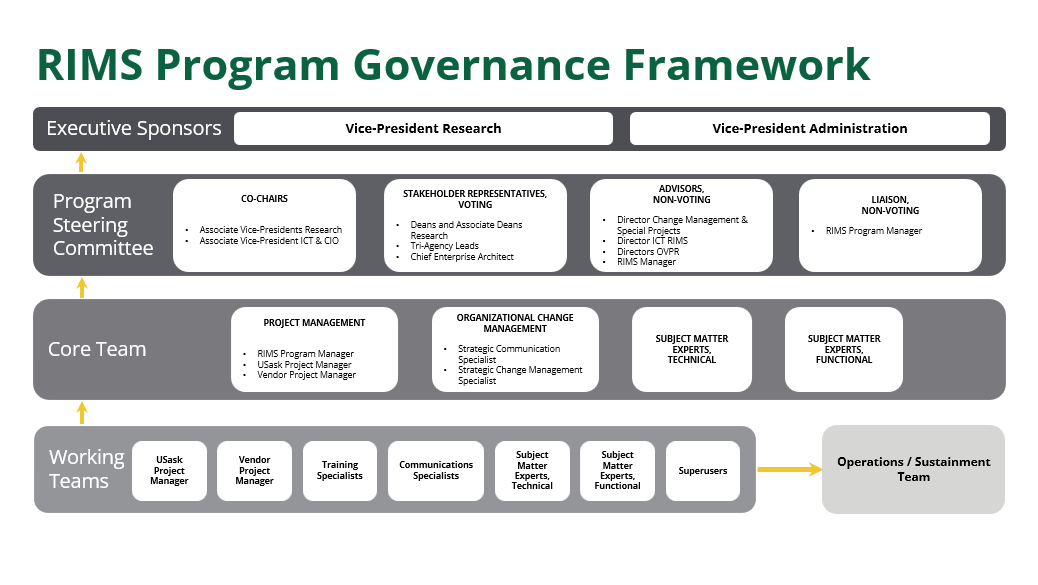
The Office of the Vice-President Research and the Office of the Vice-President Administration initiated the Research Information Management (RIMS) program, a collaborative, multi-year, initiative intended to modernize systems and processes that support research across campus. The RIMS Program Steering Committee provides additional leadership and oversight, comprised of stakeholders from USask colleges and units.
Executive Sponsors

Vice-President Research

Vice-President Administration
Program Steering Committee 2026-27
Committee membership will change over time as terms on the committee are renewed.
Michael Barr, Associate Vice-President and Chief Information Officer, Information and Communications Technology and RIMS Project Co-chair
Darcy Marciniuk, Associate Vice-President Research and Professor Respirology and Sleep Medicine and RIMS Project Co-chair
Dawn Wallin, Associate Vice-President Research Engagement and RIMS Program Senior Advisor
Terry Fonstad, Associate Vice-President Research (Ethics and Infrastructure) and RIMS Program Senior Advisor
Julia Boughner, Professor Anatomy, Physiology and Pharmacology
Debby Burshtyn, Dean of the College of Graduate and Postdoctoral Studies (CGPS) and Professor in the department of Biochemistry, Microbiology and Immunology, College of Medicine
Trever Crowe, Associate Dean (Research and Graduate Studies) and Associate Member
Sarah Forgie, Dean of Medicine
Chris Gaschler, Deputy Chief Information Officer and Chief Enterprise Architect
Alix Hayden, Director Innovation Mobilization and Partnerships
Jason Hlady, Director, Research, Library and Data Centre Technologies and RIMS Program Manager, and AMS project Co-sponsor
Susan Jelinski, Director, Human Research Ethics, Research Ethics and Infrastructure
Candace Leuschen, Executive Clinical and Research Assistant, AVPR-Health
Steven Rayan, Director, Centre for Quantum Topology and Its Applications (quanTA) and Professor, Mathematics and Statistics
Kurtis Swekla, University Veterinarian, Director of Animal Care and Research Supports and AMS Project Co-sponsor
Lynn Weber, Associate Dean, Research and Graduate Studies, WCVM | Professor, Department of Veterinary Biomedical Sciences
Guiding Principles
These principles ensure that the Research Information Management System program supports research excellence through efficient, secure, and responsive administration. They establish shared responsibility among all stakeholders for successful technology delivery, guide decision-making, and maintain focus on our objectives. Through these principles, we balance research excellence with institutional sustainability.
- Prioritize solutions that deliver broad institutional benefits while supporting research innovation
- Make strategic technology investments that enhance both research capabilities and institutional efficiency
- Evaluate decisions based on their institution-wide impact and long-term sustainability
- Demonstrate clear value through measurable improvements in research administration
- Ensure systems are accessible to all researchers, including those with diverse needs and backgrounds
- Continuously gather and act on feedback from the research community to refine and enhance system functionality
- Provide systems that are intuitive, and researcher focused, reducing administrative burdens and enhancing productivity
- Evaluate unique research requirements to balance innovation with sustainable processes and resources
- Maintain compliance with ethical guidelines, regulatory requirements, and institutional policies governing research practices
- Protect sensitive research data through robust yet unobtrusive security measures
- Promote responsible data stewardship treating research data as a shared institutional asset
- Facilitate compliance reporting through standard system features that minimize administrative burden
- Invest in systems that adapt to evolving research needs, regulatory requirements and technology advancements
- Prioritize system configuration over customization unless specialized requirements clearly justify alternatives
- Create seamless connections between research systems and broader institutional systems through industry-standard integration practices
- Share responsibility among stakeholders for system sustainability and evolution
- Foster effective partnerships across researchers, research administration, and technology teams
- Support multi-institutional research through standardized yet flexible processes
- Enable knowledge sharing while protecting institutional and research assets
- Build reliable research support systems through strategic technology choices
- Promote a "one team" mindset focused on institutional success